
Training: new vision, new tools
(Version en français plus bas)
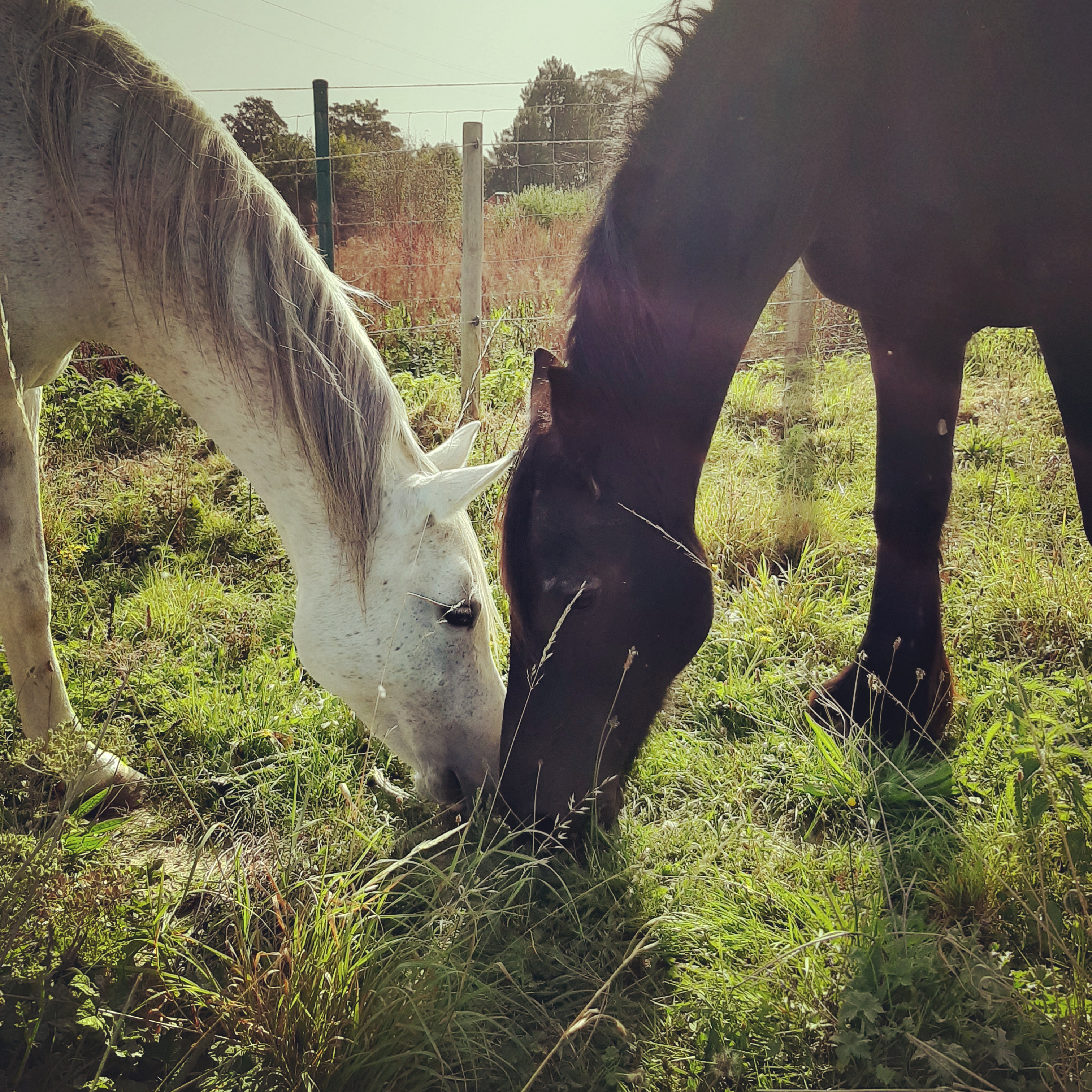
There’s a particular kind of silence that settles over a group the first time they stand in a paddock with a horse who is under no obligation to approach them. No rope. No round pen pressure. No riding to hide behind. Just presence, and whatever the horse decides to do with it.
That silence is where our training begins.
Why train with equicoaching at all?
Coaches and facilitators come to us for different reasons, but the thread running through nearly all of them is the same: they are curious and wish to explore new paths. Talk therapy and traditional coaching are powerful, but they work almost entirely through the verbal, cognitive channel and so much of what shapes a person’s life happens beyond that layer, in the nervous system, in patterns of approach and avoidance they can’t articulate because they’ve never had to see them reflected back.
Horses, as animals with an acute sensitivity to incongruence, do this reflecting naturally. A horse doesn’t respond to what a person says about themselves; it responds to what’s actually happening in their body, their breath, their intention. This gap between the story someone tells and what the horse notices is often where the real work starts.
What the training covers
Our programme is built on nearly two decades of field experience and grounded in Equine Facilitated learning methodology, and it moves across three aspects:
Theoretical foundations: co-regulation science and polyvagal theory, equine ethology and herd dynamics, and the group dynamics that shape any facilitated session. Participants need to understand not just what they’re seeing when a horse shifts its weight or turns an ear, but why, physiologically and behaviourally, it matters.
Supervised (and safe) practice: participants work directly with horses at liberty, no riding, no round pen coercion, under supervision and receiving feedback.
The ethical pillar: perhaps the most important thread, and the one most training programmes skip. We return again and again to the idea of the horse as sovereign partner, not tool, not metaphor-generating prop. This shapes everything: how sessions are designed, how consent and refusal are read and respected, how a facilitator holds the line between using a horse’s responses and imposing a narrative onto them.
What participants leave with
By the end, participants are equipped with a new vision, enlarged horizons, tools and techniques to add to their practice: attentive to nuance, comfortable with the discomfort and skilled at reading the subtle signals of presence, boundary, and trust that this work is built on.
Training is offered in English, French, or Italian, 20km south of Brussels, in Brabant Wallon, in small groups that allow for real hands-on experience rather than passive observation.
If you’ve felt your own practice reaching for something conversation can’t quite hold, this might be worth a conversation.
La formation: nouvelle vision, nouveaux outils
Il y a un silence particulier qui s’installe dans un groupe la première fois qu’il se tient dans un paddock face à un cheval qui n’a aucune obligation de s’approcher. Pas de longe. Pas de pression de rond de longe. Juste une présence, et ce que le cheval décide d’en faire.
C’est dans ce silence que commence notre formation.
Pourquoi se former
Les coachs et facilitateurs qui viennent chez nous ont des raisons différentes, mais un même fil les relie presque tous : la curiosité et l'envie de découvrir des nouveaux chemins au-delà des mots.
Les chevaux, en tant que animaux dotés d’une sensibilité aiguë à l’incongruence, ouvrent la voie vers une nouvelle compréhension de soi et de l'autre. Un cheval ne répond pas à ce qu’une personne dit d’elle-même ; il répond à ce qui se passe réellement dans son corps, son souffle, son intention. Cet écart entre le récit que l’on énonce et ce que le cheval perçoit est souvent le point de départ du véritable travail.
Ce que couvre la formation
Notre programme, fondé sur près de vingt ans d’expérience de terrain et ancré dans l'apprentissage facilité par les chevaux, se déploie comme suit :
Fondements théoriques: sciences de la co-régulation et théorie polyvagale, éthologie équine et dynamique de troupeau, ainsi que la dynamique de groupe propre à toute séance facilitée. Les participants doivent comprendre non seulement ce qu’ils observent lorsqu’un cheval déplace son poids ou bouge une oreille, mais pourquoi, physiologiquement et du point de vue du comportement, cela compte.
Pratique supervisée et en sécurité: les participants travaillent directement avec des chevaux en liberté, sans monter, sans contrainte de rond de longe, sous supervision et en recevant un retour sur leur propre régulation.
Le volet éthique: l'aspect le plus important, et celui que la plupart des formations négligent. Nous revenons sans cesse à l’idée du cheval comme partenaire souverain, non comme outil, non comme accessoire ou source de métaphores. Cela façonne tout : la conception des séances, la manière de lire et de respecter le consentement ou le refus, la ligne que doit tenir un facilitateur entre s’appuyer sur les réponses ou imposer un récit.
Ce que les participants emportent avec eux à la fin de la formation
Au terme de la formation, les participants ne repartent avec une nouvelle vision de la relation, des nouveaux outils et techniques à ajouter à leur pratique existante. Ils repartent attentifs aux nuances, à l’aise avec l’inconfort de ne pas contrôler le comportement de l'autre, capables de lire les signaux subtils de présence, de limites et de confiance sur lesquels repose ce travail.
La formation est proposée en français, anglais ou italien, à 20km à sud de Bruxelles, dans le Brabant wallon, en petits groupes permettant une réelle expérience plutôt qu’une observation passive.
Si vous sentez votre propre pratique tendre vers quelque chose que la parole seule ne peut contenir, cela vaut peut-être une conversation.


Comments