
THE CONVERSATION BEYOND WORDS
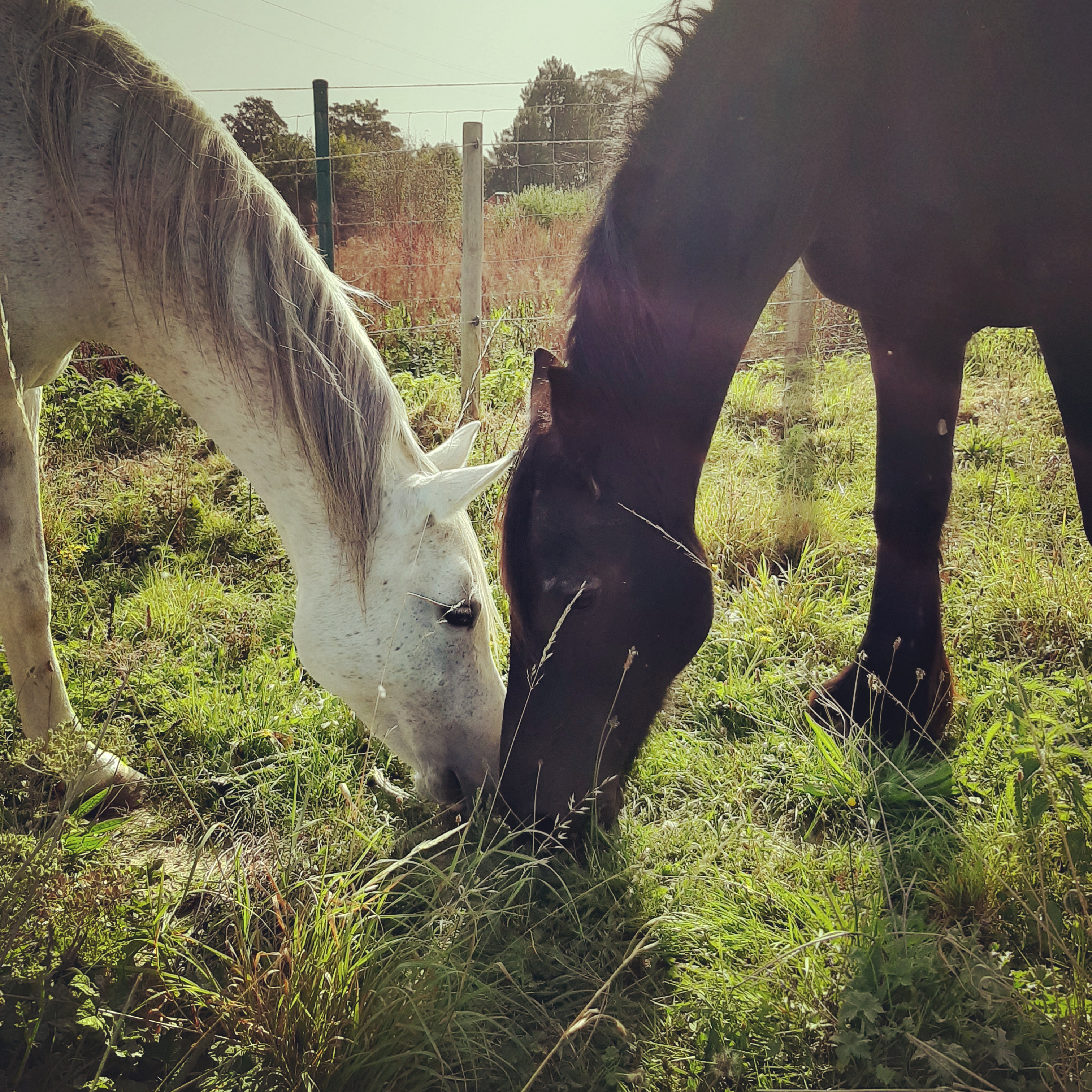
(synthèse en français à la fin de l'article)

Horses and the neuronal language of connection
Anyone who has spent time around horses knows that something goes on between us and them — something that isn’t quite vision, isn’t quite sound, and doesn’t need words. Science is now beginning to give that feeling a name.
There is a moment many of us recognise: we arrive at the paddock carrying the invisible weight of frustration or some sadness, and before uttering a word, before doing anything at all, the horse approaches us differently. Or, sometimes, he doesn’t come at all. The horse simply knows. We used to call it intuition — ours, or his, hers — and leave it there. But researchers are now showing that this silent and subtle exchange has a measurable, physiological architecture. Neurons fire. Hormones shift. Hearts start to follow each other’s rhythm.
Two brains, one circuit
The horse’s brain is not the same as ours. While the human frontal cortex runs extensive planning and reflection, the horse operates through a deeply embodied, sensory intelligence — attuned above all to movement, posture, breath, and the quality of presence in any living creature nearby. What Janet Jones, a cognitive neuroscientist who has trained hundreds of horses, describes in her work is essentially a two-way neural circuit: when rider and horse are in real communication, neurons are activated and pass from the equine brain into the human touch, up through the human nervous system, and back again — a continuous loop of information exchanged faster than thought.
The physical contact between horse and human — the hand, the leg, the weight distributed in the saddle — creates a channel through which each party continuously reads and responds to the other. A subtle shift of fingers. A tension through the rider’s lower back. An almost imperceptible softening of the horse’s jaw. These are not signals we consciously choose to send; they are the nervous system’s own language, moving beneath awareness.
The body keeps score and so does the horse
What makes horses exceptional is the huge surface area of this exchange. With a horse, we are in constant body contact. Every breath we take, every tiny tension in our hip or shoulder, travels through the point of contact and reaches the horse’s extraordinarily sensitive nervous system. Horses react to a touch as light as that of a fly landing on their coat. Horses "read" us, always, with a precision we can barely imagine.
Stress travels
The same sensitivity that makes horses amazing companions also makes them our most honest mirrors. Research has repeatedly shown that a human’s emotional state — particularly stress and anxiety — is detectable in the horse’s behaviour long before the human has acknowledged it consciously. A calm, experienced horse handler produces measurable reductions in their own cortisol during the interaction with horses. A nervous or tense human can increase the horse’s excitement without meaning to, without even knowing they are doing it.
This is not the horse being difficult or unpredictable. It is the horse being precisely what he or she is: a highly sensitive and responsive animal whose evolutionary survival depended on reading the internal states of those around the herd with precision. When the environment is quiet and the other animals are calm, the world is safe. When another being nearby is afraid or stressed, the whole herd needs to know. We humans have inherited the benefit of this extraordinary sensitivity without always remembering what it originally served or that we do possess it.
An experience in the paddock
The first time Sofia came to the yard, she stood at the gate for a long time before coming through. She had grown up between two countries, two languages, two sets of expectations — never quite at home in either — and somewhere along the way she had learned to hold herself very still and very contained, in the way people do when they are not sure they belong. She told me later she had almost turned back.
Luna was in the far corner of the paddock when Sofia arrived. Luna is not, by nature, a horse who rushes toward strangers. She is attentive, a little stand-offish, fiercely selective — and I have learned to trust her judgement. But that morning, without any invitation, she walked the full length of the paddock and stopped in front of Sofia, close enough for the woman to feel her breath, and waited.
What the science would tell us is that Luna had perceived something in Sofia’s nervous system — perhaps the tension in her muscles, the controlled breathing or her posture. Horses read these signs constantly, involuntarily, the way the rest of us read a face. Sofia later told me thats she felt "being seen" and added “It was the first time someone had come closer to me — without needing me to be anything other than who I was.”
Since then, their equine facilitated sessions have been peaceful and gentle — mostly groundwork, mostly just hanging out together. Luna doesn’t rush. Nor does Sofia. It seems that they are teaching each other the same lesson: that belonging doesn’t require us to explain ourselves. We only have to show up, and be.
Presence as practice
What comes out from the science — and from stories like Sofia’s — is something that will resonate with anyone who has approached a horse in genuine stillness and authenticity: the quality of presence is not some vague concept. It is a physiological reality. The nervous system we "bring" to the horse shapes the horse's response to us. The connection is bidirectional and quite literal: two biological systems in conversation, each continuously adjusting to the other.
This is why so many people speak of horses as healers, as teachers, as a way that allows the reconnection with the self. It is not only symbolic. When we slow down our breath, soften our gaze, quieten our internal noise enough to simply be present with a horse, the research shows that our hearts begin to synchronise, our stress hormones settle, and we enter in a state of genuine biological resonance.
THE RESEARCH
A 2024 study from the University of Pisa, published in iScience, set out to measure something most horse people have felt but couldn’t prove: physiological synchrony between humans and horses. Using heart rate variability (HRV) recordings from both species simultaneously, researchers found directional coupling between human and equine nervous systems — meaning the two were genuinely influencing each other’s autonomic states, not merely responding to the same environment.
Separately, work published in Animals (2025) found that when humans simply stood near horses or gently rubbed their necks, oxytocin — the hormone associated with social bonding and trust — increased significantly in the horses. Cortisol, the stress marker, remained unchanged in both species. The interaction, even without riding, without training, was enough to activate the horse’s bonding chemistry.
Earlier studies had already shown that activities like grooming produced synchronised peak frequencies in heart rate variability between human and horse — the two systems falling, quite involuntarily, into the same rhythm.
FURTHER READING
Horse Brain, Human Brain: The Neuroscience of Horsemanship — Janet L. Jones, PhD · 2020.
Unveiling Directional Physiological Coupling in Human-Horse Interactions — Callara, Scopa et al. · iScience, August 2024.
The Effects of Human–Horse Interactions on Oxytocin and Cortisol Levels — Jung & Yoon · Animals, March 2025.
========VERSION FRANÇAISE========
La conversation au-delà des mots
Ceux qui ont passé du temps avec les chevaux le savent : il se passe quelque chose entre nous et eux qui échappe aux mots. La science commence aujourd’hui à nommer ce phénomène.
Des chercheurs de l’Université de Pise ont démontré en 2024 que les systèmes nerveux du cheval et de l’être humain s’influencent mutuellement de façon mesurable et il s'agit d'une synchronisation physiologique réelle, et non d'une simple coïncidence. D’autres études ont montré qu’un contact aussi simple que se tenir près d’un cheval, ou lui caresser l’encolure, suffit à faire augmenter l’ocytocine — l’hormone du lien — chez l’animal et chez l'humain et que le rythme cardiaque des deux êtres tend, spontanément, à entrer en resonance.
Le cheval est un miroir d’une précision redoutable. Il perçoit notre état intérieur avant même que nous en soyons conscients — la tension dans nos muscles, la qualité de notre respiration, le poids de nos frustrations. Ce n’est pas de la magie. C’est de la neurologie.
L’histoire de Sofia et Luna l’illustre parfaitement. Sofia — une femme ayant grandi entre deux pays, deux langues, sans jamais tout à fait trouver sa place — est arrivée un matin à la barrière du paddock, hésitante. Luna, une jument souvent un peu distante avec les inconnus, a traversé tout le pré pour venir s’arrêter devant elle. Sans raison apparente. Simplement là, présente. Sofia m'a dit plus tard : “C’était la première fois que quelqu'un me voyait vraiment — sans me demander d’être autre chose que ce que j’étais, que je suis.”
Ce que la science nous apprend, et que dans le paddock nous savions déjà, c’est que la qualité de notre présence n’est pas une notion vague. C’est une réalité physiologique. Le système nerveux avec lequel nous approchons le cheval façonne la réponse qu’il nous renvoie. La connexion est réelle, bidirectionnelle, et plus ancienne que tous nos mots.


Comments